Staff Nurse NYU Langone Brooklyn Brooklyn, New York, United States
Disclosure(s):
Madelaine Catcho, RN: No financial relationships to disclose
Description: While perioperative staff work tirelessly to help and heal others, they constantly risk injuring themselves. The Association of perOperative Registered Nurses (AORN) recognizes three major occupational hazards in the perioperative environment: respiratory issues from surgical smoke exposure, musculoskeletal injuries from patient transfer and positioning, and sharps injuries.
Working with sharps such as needles, blades, saws, and instruments is routine in various procedures. Despite the known risk of bloodborne pathogen exposure, however, many staff members remain unsure of what to do after a sharps injury. The lack of time-sensitive knowledge may come from inexperience, embarrassment, or the assumption that the steps to protect themselves are unnecessary or obvious.
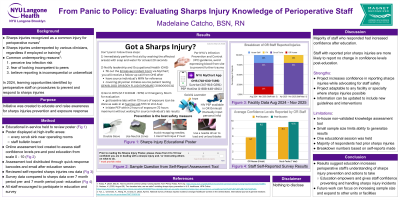
In 2024, one perioperative nurse from a large academic teaching hospital had recognized a concerning issue in the perioperative department: staff members, including witnesses, were unsure how to respond. This uncertainty caused delay in essential care, anxiety, frustration, and panic. In one incident, a staff member was only instructed to wash their hands and was sent home without further evaluation or source testing. These incidents motivated the nurse to advocate for a safer sharps environment and raise awareness of sharps safety.
To address these knowledge gaps, an educational poster was created, outlining the sharps injury policies and interventions. It consolidates hospital policies, AORN guidelines, and practical information such as how and where to submit an employee incident form and blood testing locations. The content was reviewed and verified by managers, resource nurses and scrub technologists, and the hospital's occupational health department to ensure accuracy and relevance.
The poster is displayed in high traffic areas including every scrub sink near each operating room and staff bulletin boards. Additionally, an in-service training was provided to perioperative staff. The education primarily targets perioperative nurses and surgical technologists, but includes all personnel working with sharps, such as medical students and residents, anesthesia residents, physician assistants, and attending surgeons and anesthesiologists.
While data comparing sharps injuries from 2025 to 2024 is still pending, staff are self-reporting increased knowledge and confidence in managing sharps injuries following these interventions. This suggests these efforts are both effective and essential. Although they do not eliminate sharps injuries, it does foster a safe and nonjudgmental culture where staff safety is prioritized with patient safety.
Although ongoing staff education may seem redundant, reinforcing essential knowledge can prevent the development of dangerous, often incurable, and fatal diseases. While perioperative staff prioritize providing quality care and safety for their patients, they also deserve this same level of care and protection.