Clinical Practice Educator University College London Hospitals NHS Foundation Trust London, England, United Kingdom
Disclosure(s):
Joana Oliveira Rosa, n/a: No financial relationships to disclose
Description: Problem/Purpose For the past twenty years, nurses have mentored an increasing number of students in the operating theatre/room (OR) to counteract worldwide staff shortages. Still, the dual role of scrub/circulation in British intra-operative nursing is challenging, particularly in neurosurgery. Moreover, theoretical intra-operative nursing remains excluded from the British Nursing Curricula. The knowledge about nursing mentors' experiences is essential to inform how clinical areas and universities can support staff, with the subsequent potential recruitment (Wareing et al 2017). Since nurses are their profession's gatekeepers, mentoring in the OR is also an ethical imperative for future patient safety.
Literature Review Previous research considers mentoring a burdensome additional nursing role (Omansky 2010). Literature patterns include facilitation of learning, mentoring benefits (knowledge update), constraints (time), lack of preparation/support and difficulty of assessment (Jokelainen et al 2011). However, most studies concentrate on ward nursing (McClure & Black 2013). Despite some literature focusing on students' experiences in ORs (Meyer et al 2016), no research currently focuses on intra-operative nurses.
Research Question/Hypothesis This study explored nurses lived experiences of being Nursing mentors in the intra-operative neurosurgical theatre/room.
Conceptual Framework Hermeneutic Phenomenology was applied to the research data collection, analysis and dissemination of results.
Methodology Seven intra-operative neurosurgical nurses volunteered and were interviewed in-depth. Unstructured interviews, revolving around the research question, lasted up to two hours and were audio-recorded. The inclusion criteria comprised prior mentoring training and supporting at least one nursing student in the neurosurgical OT. The sample was representative: five female and two male nurses, aged between 20-40 years old, with neurosurgical intra-operative experience of 2-20 years.
Data analysis Data analysis started during the interview and was led by the participants' stories. These were clarified with paraphrasing and analogies, to become fused with the researcher's horizons of understanding (Gadamer 1960). Data analysis followed Heidegger's hermeneutic circle, with interpretations emerging through Gadamer's fusion of horizons.
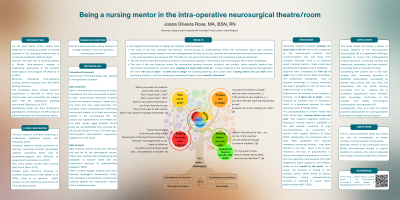
Results The relationship between mentors, context, and students led to four interlinked interpretations. Mentoring students required 'keeping too many balls in the air' due to the complexity of the context and dual clinical role. Students were considered as 'fish-out-of-water' due to their lack of basic knowledge. Expectations for students to be invested in learning—as it 'takes two to tango' —were hindered by their lack of motivation. The unpreparedness to mentor meant that most nurses 'run before they could walk'. Hence, assessment often resulted from the 'benefit of the doubt'.
Conclusions/Discussion This study showed that being a nursing mentor in the intra-operative neurosurgical OR is a significant challenge, regardless of nurses' prior education, clinical/mentoring training and experience, and students' knowledge/motivation to learn.
Perioperative Nursing Implications There seems to be a need for further academic, professional and clinical support for intra-operative neurosurgical nurses to mentor students.
AORN Guideline being referenced: Perioperative Education

.jpg "Joana Oliveira Rosa, MA (she/her/hers) photo")