Founder/CEO Society for Nurses in Endoscopy and Minimally Invasive Surgery-Nigeria West Fargo, North Dakota, United States
Disclosure(s):
Johnson O. Ogundare, DNP, MPH, CNOR, RN: No financial relationships to disclose
Description:
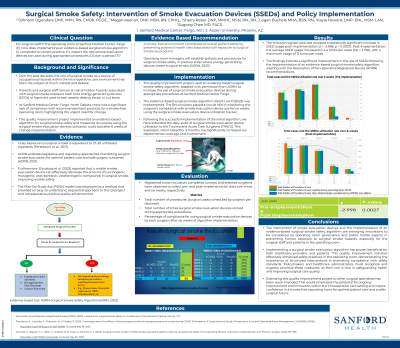
Background: Surgical smoke generated in operating rooms from the use of energy-generating devices or lasers remains one of the most significant health risks for patients and surgical staff despite the use of standard surgical masks. While 18 U.S. states mandate that hospitals and ambulatory surgical centers adopt surgical smoke safety policies, North Dakota needs more practical and empirical implementation. This quality improvement project used an evidence-based surgical smoke safety algorithm to increase the use of surgical smoke evacuation devices during appropriate procedures at Sanford Medical Center Fargo.
Method: A descriptive pre-post design was employed in this project to compare the surgical smoke evacuation utilization rate before and after the implementation of the algorithm. The process involved the purposive selection of five surgeons from five surgical specialties, whose surgical smoke evacuation practices were observed. Circulating nurses completed surveys, and selected surgeons were observed to collect pre- and post-implementation data over three and six weeks, respectively. The summary statistics of the chosen surgeons' use of surgical smoke evacuation devices (SSEDs) at the facility were examined and analyzed before and after implementing the evidence-based algorithm. Descriptive statistics were utilized, while Spearman's rank correlation coefficient at a 5% level of significance and inferential statistics (Chi-squared) were employed to test the hypotheses.
Results: The findings from this quality improvement project underscore the significant difference in the use of SSEDs between pre-and post-implementation of the evidence-based surgical smoke safety algorithm. This difference demonstrates the valuable role of our surgical staff in implementing these safety measures, thereby emphasizing the impact of our research on overall patient outcomes.
Conclusion: The absence of an evidence-based algorithm for surgical staff's decisions on using surgical smoke evacuation devices during appropriate procedures in an operating room environment poses higher occupational health risks that may impact patient surgery outcomes. It is crucial to work in an operating room with surgical smoke safety measures recommended by the Association of periOperative Registered Nurses (AORN). Keywords: Surgical smoke, operating room, surgical staff, surgical smoke evacuation device

.jpg "Johnson O. Ogundare, DNP, MPH, RN, CNOR, FAORN (he/him/his) photo")