Unit Educator in the Bell Operating Room The University of Kansas Health System Lenexa, Kansas, United States
Disclosure(s):
Lorie A Hassel-Chuang, BSN, RN: No financial relationships to disclose
Description: Description of Team
A multidisciplinary perioperative team, including Circulators, surgical technologists, infection prevention specialists, environmental Health and safety Specialists, a research mentor, the innovation department and an engineering capstone project. We collaborated to evaluate and improve sponge counting systems to enhance patient safety and staff workflow.
Preparation and Planning
The team identified concerns with traditional sponge counting systems, including risks of cross-contamination, limited visibility, and ergonomic workflow limitations. A review of current practices and infection control standards guided the development of a new solution. AORN Guideline for the Prevention of Retained Surgical Items 1 and AORN Guideline for Environmental Cleaning 2
Assessment
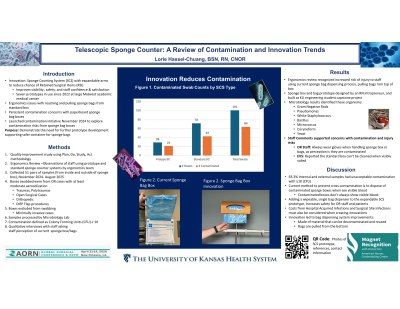
Contamination and ergonomics studies were conducted to assess the limitations of existing sponge boxes and bags. Data revealed elevated colony-forming unit (CFU) levels and disinfection challenges with the current sponge boxes and bags. The telescopic portion of the sponge counter improves visibility and improves staff satisfaction, which improves time efficiency and compliance with hospital policies for accurate sponge counts.
Implementation
A prototype telescopic sponge counting system (SCS) has been trialed since 2022. The last phase of this SCS project introduced a disinfectable sponge box and bag design. The system was tested in clinical simulations to evaluate its effectiveness in reducing contamination and improving count accuracy and ergonomics.
Outcome
The new system demonstrated a significant reduction in CFU levels compared to traditional methods as it allows for disinfection, aligning with infection prevention standards. Enhanced visibility and ergonomic design streamlined the counting process, saving time and improving staff satisfaction.
Implications for Perioperative Nursing
This innovation supports a coordinated strategy toward zero harm by reducing the risk of retained surgical items and cross-contamination. The improved workflow and infection control measures contribute to safer surgical environments and increased staff efficiency. A cost-benefit analysis is being investigated to support long-term adoption and justify investment. Guideline for Medical Device and Product Evaluation 3