Registered Nurse New York Presbyterian Queens Hospital Flushing, New York, United States
Disclosure(s):
Congyan Yu, RN, CNOR: No financial relationships to disclose
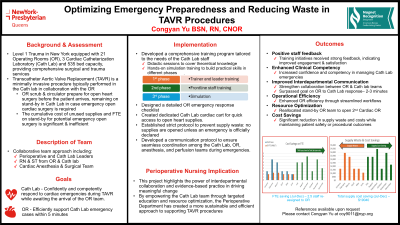
Description: Transcatheter Aortic Valve Replacement (TAVR) is a minimally invasive procedure typically performed in the Cardiac Catheterization Laboratory (Cath Lab). During these procedures, the Cath Lab team works closely with the Cardiologist to ensure a smooth and safe intervention. However, due to the potential risk of complications that may require emergency conversion to open-heart surgery, the Operating Room (OR) has traditionally deployed a Cardiac OR Nurse and a Surgical Technologist to the Cath Lab. The OR team is responsible for setting up instruments and disposable supplies in anticipation of conversion to open-heart. While this precautionary measure is rooted in patient safety, it comes with a significant financial and operational cost. The cumulative cost of unused and discarded supplies becomes substantial. Moreover, this practice ties up valuable OR personnel and resources that could otherwise be allocated to other critical cardiac procedures.
Recognizing the inefficiencies of this approach, the OR Cardiac Team convened to evaluate the current workflow. The team identified an opportunity to improve both resource utilization and operational efficiency without compromising patient safety. A collaborative team of Registered Nurses (RNs), Surgical Technologists (STs), Operating Room and Cath Lab leadership developed a comprehensive training program tailored to the specific needs of the Cath Lab staff. The program included didactic sessions to cover theoretical knowledge, hands-on simulation training to build practical skills, and the implementation of a detailed emergency response checklist. The goal was to ensure that the Cath Lab team could confidently and competently respond to emergencies while awaiting the arrival of the OR team. To support this new workflow, a dedicated Cath Lab cardiac cart was assembled. This cart contains a carefully curated inventory of essential instruments and supplies required for emergency open-heart procedures. A strict protocol was established: no supplies are to be opened unless an emergency is officially declared. This measure alone significantly reduces waste and preserves resources. The training program was rolled out in phases, beginning with Cath Lab leadership and followed by frontline staff. Feedback from participants was overwhelmingly positive, with many expressing increased confidence in their ability to manage emergency situations. The initiative also included the development of a communication protocol to ensure seamless coordination between the Cath Lab, OR, anesthesia, and perfusion teams during emergencies. Since implementing this new process, the OR has successfully reallocated staff and resources to support additional cardiac cases, resulting in enhanced departmental efficiency and improved financial performance. These savings are achieved without compromising patient safety or procedural outcomes. The success of this initiative highlights the power of interdepartmental collaboration and evidence-based practice in driving meaningful change. By empowering the Cath Lab team through targeted education and resource optimization, the organization has created a more sustainable and efficient model for managing TAVR procedures. The project has been well-received by Cath Lab staff, OR personnel, cardiac providers, and hospital administrators alike.