Associate Nurse Manager Parkland Hospital Dallas, Texas, United States
Disclosure(s):
Lauren Huset, BSN, RN, ONC, CNOR: No financial relationships to disclose
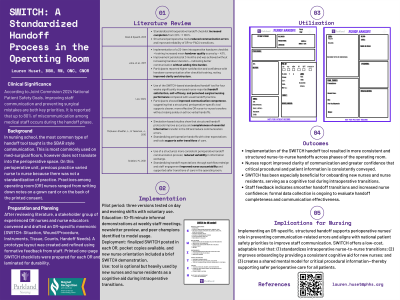
Description: Handoff communication between operating room (OR) nurses is a critical yet vulnerable point in the perioperative process. Communication breakdowns during intraoperative handoffs can lead to delays and errors in patient care. According to The Joint Commission's 2024 National Patient Safety Goals, improving staff communication and preventing surgical mistakes are key priorities — both of which are addressed by enhancing nurse-to-nurse handoff practices in the OR. Traditional handoff practices among OR nurses often lack consistency and structure, particularly in high-acuity or fast-paced surgical environments. Literature supports the use of structured handoff tools to improve communication and patient safety. However, limited standardized tools exist specifically designed for OR nurse-to-nurse transitions. A customized tool tailored to the perioperative environment was needed to ensure continuity and reduce the risk of error during care transitions. Can the implementation of a standardized, OR-specific handoff tool improve the consistency, efficiency, and effectiveness of intraoperative nurse-to-nurse communication? Following a review of current literature on nursing handoff communication — particularly within surgical settings — the SWITCH format (Situation, Wound/Procedure, Instruments, Timing, Complications, Handoff Needs) was adapted as a comprehensive, OR-specific handoff structure. Several versions of the SWITCH checklist were piloted and refined based on nurse feedback. The final version was designed to be used throughout the perioperative process, from preoperative planning through intraoperative transitions and postoperative handoff. SWITCH handoff tools were printed and placed in every OR suite, available for nurses to use at their discretion. Nurses were introduced to the tool through informal education sessions at weekly staff inservice meetings and previewed in the perioperative newsletter. Nurse feedback led to continued updates to improve usability and relevance of the tool. While use of the tool is optional, it has been widely adopted, especially among new nurses and nurse residents who report increased clarity and confidence during handoffs. Implementation of the SWITCH handoff tool has led to more consistent and structured nurse-to-nurse handoffs in the perioperative space. Nurses report that the tool improves clarity of communication and helps ensure all critical information is conveyed. The tool has been especially valuable for onboarding new staff, providing a guide for safe and comprehensive patient care transitions. While formal data collection is ongoing, anecdotal feedback supports improved nurse confidence and smoother handoff transitions. The SWITCH handoff tool has proven to be an effective, user-friendly resource for supporting safe and structured communication among OR nurses. By providing a standardized framework for information exchange, the tool helps reduce variability in practice and mitigates the risk of communication-related errors during surgical procedures. Perioperative nurses play a key role in ensuring patient safety during transitions of care. The SWITCH handoff tool empowers nurses with a consistent, evidence-based resource to improve communication during intraoperative handoffs. As national guidelines increasingly emphasize structured handoff protocols, SWITCH serves as a practical, adaptable model that aligns with best practices and promotes safe perioperative care.