Perioperative Services Manager - Neurosurgery ORs Vanderbilt University Medical Center Nashville, Tennessee, United States
Disclosure(s):
Daphny Peneza, DNP, RN, CNOR, CSSM, FAORN: No financial relationships to disclose
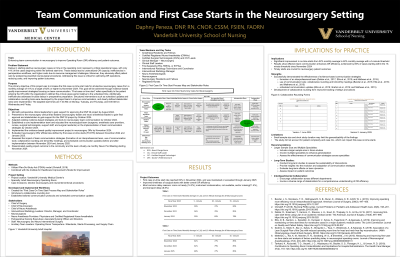
Description: The primary aim of this project was to increase the first case on-time start rate in elective neurosurgery cases from a monthly average of 41% to an average of 62% or higher by November 2024 through evidence-based quality improvement strategies in team communication. This quality improvement (QI) project utilized the Plan-Do-Study-Act (PDSA) model in conjunction with the Institute for Healthcare Improvement's Model for Improvement. Conducted at Vanderbilt University Medical Center's neurosurgery operating rooms (ORs), it involved a multidisciplinary team of anesthesia providers, certified registered nurse anesthetists (CRNAs), certified surgical technologists (CSTs), clinical managers, neurosurgeons, neurosurgery residents, and registered nurses. The study included elective neurosurgery and neurointerventional cases from November 2024 to January 2025. Key interventions included the formation of an interprofessional team, the use of communication tools, and scheduled communication updates. Implementing structured communication protocols in the neurosurgery operating rooms led to a notable improvement in the timeliness of first cases on time starts (FCOTS). By November 2024, the on-time start rate had reached 62% and was maintained or exceeded by January 2025. This improvement in timeliness contributed to overall operating room efficiency. Furthermore, the most common reasons for the delay include room not ready (14.2%), instrument contamination of not being available and/or missing (11.4%), and transport delay (6.8%) of the 176 delayed cases. These findings underscore the importance of addressing logistical issues alongside enhancing communication practices to reduce delays further and improve surgical start times. Effective team communication significantly improved operating room efficiency, with on-time starts increasing from a 52% average to a 62% average within the 5-minute threshold and maintaining an 85% average within the 15-minute threshold since November 2024. This enhancement is crucial for neurosurgery patient outcomes, demonstrating the value of structured communication protocols. However, the study's single-site and short-duration nature may limit the generalizability of the findings. Future research should involve more extensive, cross-specialty studies and a more extended period to validate results and explore other factors influencing first case starts.