Assistant Vice President Surgical Services-Ambulatory Surgery Cooper University Healthcare Medford, New Jersey, United States
Disclosure(s):
Patricia Colleen Farnum, MSN, RN, CPAN: No financial relationships to disclose
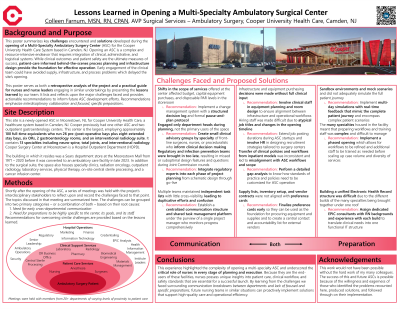
Description: This poster summarizes key challenges encountered and solutions developed during the opening of a Multi-Specialty Ambulatory Surgery Center (ASC) for Cooper University Hospital. The ASC was designed and constructed by a group that excluded those who would work in the space, leading to severe supply, infrastructure, and process problems which delayed the site's opening.
To identify causes and lessons learned, a multidisciplinary meeting was held shortly after the ASC's launch, involving stakeholders- nurses, anesthesia providers, and ancillary departments such as facilities, materials management, sterile processing, pharmacy, physical therapy, scheduling, business, IT, and radiology. The feedback was recorded and summarized.
Most problems stemmed from late inclusion of clinical staff and siloed planning. The project's scope was underestimated due to limited understanding of operational needs. Decisions were made about nurses' work processes and needs by non-nurses, which resulted in infrastructure problems like misplaced or missing outlets, non-centralized placement of status boards, and the ordering of extraneous surgical equipment. It became clear that there was a need for better communication and cooperation across teams.
Significant improvements were achieved by introducing structured, cross-disciplinary communication. A thrice-weekly meeting with all 22 departments involved allowed issues to be addressed collaboratively. A shared spreadsheet kept everyone informed of the initiatives, while walkthroughs and simulated procedures led by nurses helped identify and resolve practical issues. Nurses were empowered to directly engage with facility planners to troubleshoot and optimize the space.
These efforts allowed for the successful opening of ASC. The biggest takeaway was the need for early, consistent interdisciplinary collaboration. Several departments were needed to effectively track down problems and plan solutions together, and the only true way to discover all the problems was to bring those who would be using the spaces, particularly nurses, into the process. In the spirit of maintaining interdisciplinary communication after the conclusion of the project, committees were formed to stay on top of new information and ensure its spread to various groups.
The implications of this project for perioperative nursing come as recommendations for any nurses or nurse leaders who are involved in similar projects. Nurses should be involved in project planning. They are instrumental in creating spaces that prioritize patient safety and effective care. Staff hiring and equipment purchasing must be started early so nurses can be oriented and trained with equipment. Finally, design decisions should be made using the AORN Guidelines as a framework. Those which informed this project were the Guidelines for Design and Maintenance, Team Communication, Environment of Care, and others.