Surgical Services Educator Bethesda Hospital West, Baptist Health South Florida Lake Worth, Florida, United States
Disclosure(s):
Lisa S. Pittington, MSN, RN, CNOR: No financial relationships to disclose
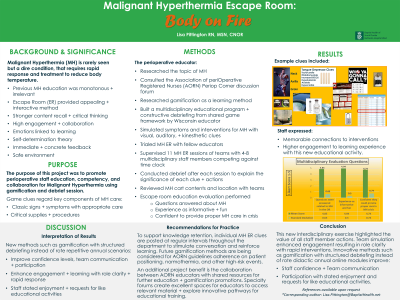
Description: Malignant Hyperthermia (MH) is rarely seen but a dire condition, requiring rapid response and treatment. Staff without an MH experience may see previous MH education methods as hypothetical, boring, and repetitive. An appealing and interactive method was needed to enhance engagement, solidify learned behaviors, and provide rationales. A systematic review of escape room education revealed high engagement, motivation, participation, and collaboration as primary benefits, with stronger recall of content. Escape rooms employ higher levels of critical thinking, using complex Bloom's taxonomy verbs like analyze, synthesize, and evaluate. Gaming activities pull emotions and learned knowledge together to create stronger recall. Time limits create urgency and disrupt the tendency to daydream. Senses are aroused as the brain is challenged to interpret data for future real-life scenarios. Self-determination theory is implied as participants feel in control of their role, proficient, and connected to teammates. The learner wrestles through the game in a safe environment and meets the intended objectives with immediate and concrete feedback. Interprofessional teams decrease poor communication and safety errors. The perioperative educator researched the topic and consulted the AORN Periop Corner discussion forum. A multidisciplinary educational program and constructive debriefing from a shared escape room framework by a Wisconsin educator was built with visual, auditory, and kinesthetic clues. The debrief session was conducted to explain the significance of each clue and actions, and review the MH cart and location. The project's purpose was to promote perioperative staff (RN, Scrub Tech, Other Tech, Transporter, and Unit Clerk) competency and multidisciplinary collaboration for MH education by using innovative evidence-based gamification through an interactive escape room and constructive debrief session. Objectives were for participants to recall classic signs and symptoms of MH and management by using game clues to remember location of critical supplies and procedures involved, and how to calculate Dantrolene/Ryanodex diluent and dose. The escape room simulation was prepared as a surgery setting with various clues placed around the room. Recordable buttons gave verbal clues from the surgeon and anesthesiologist, tongue depressors with invisible ink revealed signs and symptoms, and lock boxes with ice, water, and Ryanodex were solved with other related clues. Participants had 20 minutes to work together to solve the clues and rescue the patient. After the game, participants filled out an evaluation questionnaire with a Likert Scale of 1-5. The questions asked the participants to rate the learning method as informative and fun, confidence levels in a MH crisis, and debrief questions related to MH. Scores ranged from 4.74 to 4.94 revealing positive outcomes with staff expressing memorable connections and enjoyment while learning using the interactive escape room. Role clarity with rapid response in MH were also noted as learning benefits. Staff requested similar learning activities for future events.

.jpg "Lisa S. Pittington, MSN, RN, CNOR photo")