Registered Nurse Allegheny Health Network Gibsonia, Pennsylvania, United States
Disclosure(s):
Nicholas Valenta, RN: No financial relationships to disclose
Description: Problem Information management is a growing domain within perioperative nursing, yet limited resources are dedicated to how publicly available information may impact patient care. For example, layman's terms and medical terms vary wildly. As patients use social media to seek out health information, layman's search terms may not return relevant information. Inaccurate information regarding surgical complications is a barrier to care, as it may frighten patients and delay procedures.
Literature Review Most research regarding health information on social media is dedicated to infectious diseases and vaccines. Healthcare organizations provide relevant information, but there is no way to filter untrustworthy sources from searches. Few studies on surgical information on social media were identified, suggesting a need for further research.
Research Question If patients search social media for information about surgical complications, what effect does using medical terminology as a search term have on the relevance of the search results as compared to using layman's terms?
Conceptual Framework The data for this project was obtained via observational study. Reliability was ensured by using a new Incognito tab for each search to eliminate interference from previous searches and internet cookies. Validity was supported by using the same sample size and inclusion/exclusion criteria for each search term.
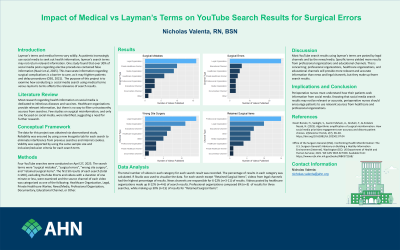
Methodology Four YouTube searches were conducted on April 27, 2025. The search terms were "surgical mistakes", "surgical errors", "wrong site surgery", and "retained surgical items". The first 50 results of each search (total n=200), excluding YouTube Shorts and videos with a duration of one minute or less, were examined and the source channel of each video was categorized as one of the following: Healthcare Organization, Legal, Private Healthcare Worker, News/Media, Professional Organization, Documentary, Educational Channel, or Other.
Data Analysis The total number of videos in each category for each search result was recorded. The percentage of results in each category was calculated. R Studio was used to visualize the data.
Results For each search except "Retained Surgical Items", videos from legal channels had the highest percentage of results, ranging between 28% (n=14) for "Wrong Site Surgery" and 52% (n=26) for "Surgical Errors". News channels are responsible for 6-22% (n=3-11) of results. Videos posted by healthcare organizations made up 8-12% (n=4-6) of search results. Private healthcare workers' channels ranged from 2-20% (n= 1-10) of results. Professional organizations composed 6% (n=3) of results for three searches, while making up 30% (n=15) of results for "Retained Surgical Items".
Conclusion Most YouTube search results using layman's terms are posted by legal channels and by the news/media. Specific terms yielded more results from professional organizations and educational channels. This is concerning; professional organizations, healthcare organizations, and educational channels will provide more relevant and accurate information than news and legal channels, but they make up fewer search results.
Perioperative Nursing Implications Perioperative nurses must understand how their patients seek information from social media. Knowing that social media search results may not be relevant or accurate, perioperative nurses should encourage patients to use relevant sources from healthcare and professional organizations.