Clinical Nurse Specialist Perioperative and Procedural Services ECU Health Greenville, North Carolina, United States
Disclosure(s):
Shawna McClung, MSN, APRN, AGCNS-BC, CNOR: No financial relationships to disclose
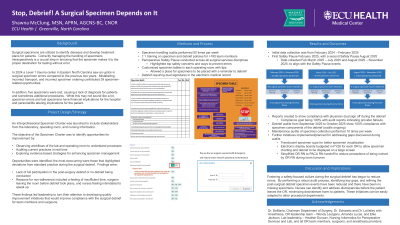
Description: In August 2024 the operating room, pathology, and informatics departments at a Level 1 trauma center in Eastern North Carolina created a Specimen Charter in response to a rise in surgical specimen errors, particularly missing ones.
Safety events involving surgical specimens prompted leadership to initiate multiple root cause analyses to identify opportunities for improvement in specimen management. AORN guidelines for Team Communication and Specimen Management were reviewed, research on evidence-based practice was conducted, and real time audits were performed. Operating room and pathology leadership partnered to observe each other's workflows for gaps. Multiple opportunities in current practice were identified, with the common root cause being deviations from standard policy during surgical debriefs.
Summer 2024 the patient safety team did a deep dive of safety events reported for specimen management year to date. Mislabeling, incorrect transport, and incorrect specimen ordering contributed to over 50 specimen-related deviations. Errors were upwardly trending compared to the previous two years, particularly in lost specimens. Two years prior the number of lost specimens was zero. As of August 2024, there were five.
Audits, when compared to guidelines and best practice, identified opportunities for improvement with labeling, ensuring orders were placed correctly, and the appropriate transport of specimens. The observers noted there was a lack of full participation in the post-surgery debrief and sometimes no debrief was conducted. The main reasons for non-adherence to policy included a feeling of insufficient time, the surgeon leaving the room before the debrief, and the nurses feeling intimidated to speak up. Adherence to the debrief policy could have prevented errors, including the loss of specimens.
Focus was placed on improving the surgeon/nurse communication during the debrief. One-on-one education was provided for all team members to allow time to review the policies as well as time for questions. The Chief of Surgery held a Safety Campaign with all medical staff. Here the top safety concerns for the past year were highlighted along with the role that medical staff play in preventing errors. Specimen tables were custom designed and placed in all operating rooms. This table gave a designated place for specimens along with key tips, phone numbers, and reminders to do the debrief. There is a place on the table to hold cups, biohazard bags, and swabs allowing the nurse to have everything immediately available. Lastly, nursing informatics updated the electronic medical record documentation to include a dual sign off with the surgeon at the time of the debrief indicating specimens were reviewed.
Team members were receptive to the education and felt more empowered to speak up during the debrief. The Safety Campaign allowed medical staff to understand past safety events and made them more aware of their roles in safety. To date there are no concerns with the specimen tables. Although the dual sign off was only implemented in June 2025, no concerns have been reported, and staff vocalize a greater sense of satisfaction in specimen management. Performing a robust audit process, identifying gaps, and refining the debrief has led the operating room to reduce specimen events to only 14 in the first half of 2025.
A structured debrief fosters accountability and communication, increases compliance and standardization, and strengthens patient safety minimizing downstream harm.