RN / Service Lead Michigan Medicine / University of Michigan Ypsilanti, Michigan, United States
Disclosure(s):
Mandy Pate, MSN, RN, CNOR: No financial relationships to disclose
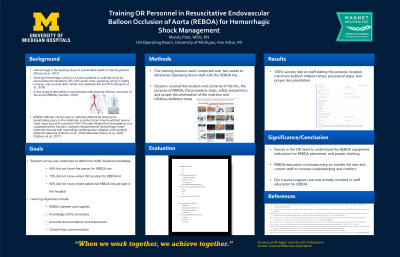
Description: Hemorrhage is the leading cause of preventable death among trauma patients (Moore et al., 2015). Resuscitative thoracotomy (RT), involving aortic cross-clamping, is often used to control hemorrhaging, but survival rates remain low (8%-31%) (Cheema et al., 2018).
A less invasive alternative, resuscitative endovascular balloon occlusion of the aorta (REBOA), has emerged (Sambor, 2018). The REBOA catheter is used in various traumatic situations, including ruptured abdominal aneurysms, penetrating abdominal or pelvic injuries, blunt traumas with positive FAST test results, suspected pelvic fractures, complex retroperitoneal hemorrhages, lower extremity traumas, and morbidly adherent placenta cases (Cheema et al., 2018; Manzano-Nunez et al., 2018; Ordonez et al., 2017).
Goals A survey revealed:
66% of staff were unaware of REBOA's reasons. 73% did not know the OR location of the REBOA kit. 90% were unaware of additional REBOA kit locations. Learning objectives were set to ensure staff understand:
The REBOA catheter and supplies. Procedural details and indications. Accurate documentation and assessment. Closed-loop communication for smooth transitions. Method Five training sessions over two weeks covered:
REBOA kit location and contents. Purpose of REBOA. Step-by-step procedural guidelines. Safety precautions. Proper documentation protocols. Results Post-training, staff showed a 100% success rate in understanding REBOA's purpose, storage location, procedural steps, and documentation practices.
Conclusion OR nurses must understand REBOA equipment, clinical indications, and proper charting. REBOA education will be conducted every six months for all staff, with trauma surgeons actively involved in the training process.