Perioperative Nurse Practitioner HMHN Ocean University Medical Center Bayville, New Jersey, United States
Disclosure(s):
Juliann J. Altman, MSN, APRN, FNP-C, CNOR, RNFA: No financial relationships to disclose
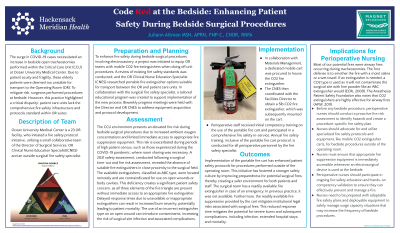
Description: Background/Problem Identification: The surge in COVID-19 cases increased bedside open tracheostomies in the Critical Care Unit (CCU) for patients too unstable for transport to the Operating Room (OR). This practice revealed a critical disparity: patient care units lack the OR's comprehensive fire safety infrastructure and protocols.
Description of the Team: Our 14-OR facility initiated this initiative with a small collaborative team: the Director of Surgical Services, OR Clinical Nurse Education Specialist (CNES), and an outside surgical fire safety specialist.
Preparation and planning: The project's goal was to equip OR teams with mobile CO2 fire extinguishers for off-unit procedures. The team reviewed safety standards, researched portable options, and developed a tailored educational program and protocols to support the new process.
Assessment: The CCU environment has an elevated fire risk during bedside surgery due to increased ambient oxygen. A 2021 safety assessment revealed the absence of suitable fire extinguishers near the surgical field. Available ABC-type extinguishers were remote and are contraindicated for open wounds, as their chemical powder can contaminate the site and increase infection risk. With all three elements of the fire triangle present, the lack of an immediately accessible, appropriate extinguisher created a significant patient safety risk for severe burns or mortality.
Implementation: In collaboration with Materials Management and Facilities, a dedicated mobile cart was procured and a 5lb CO2 fire extinguisher was mounted on it. The CNES led initial and ongoing annual competency training for all perioperative staff on the portable fire cart and comprehensive fire safety protocols.
Outcome The portable fire cart significantly enhanced patient safety for procedures outside the OR. It fostered a stronger safety culture and improved preparedness, creating a safer environment for patients and staff. The readily available, appropriate fire suppression mitigates institutional legal risks and reduces response time, which is crucial in preventing severe burns and subsequent complications.
Implications for perioperative nursing: This project has critical implications. For airway fires, common in tracheostomies, a CO2 extinguisher is essential as it does not contaminate the surgical site like an ABC extinguisher. This initiative proves the necessity of specialized fire safety protocols and equipment for non-OR settings. It emphasizes that proactive, procedure-specific fire risk assessments are crucial. Success also hinges on interprofessional collaboration. Ultimately, it confirms the need for readily accessible CO2 extinguishers, robust ongoing education with competency validation, and adaptable protocols to manage surge capacity safely.