Charge Nurse, Surgical Services White Plains Hospital yonkers, New York, United States
Disclosure(s):
Renee Velez, BSN: No financial relationships to disclose
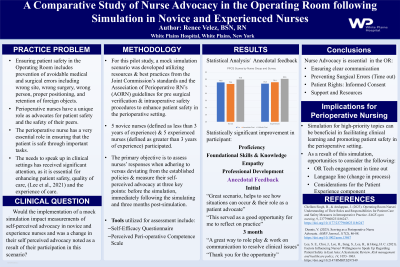
Description: Ensuring patient safety in the Operating Room includes prevention of avoidable medical and surgical errors including wrong site, wrong surgery, wrong person, proper positioning, and retention of foreign objects. Perioperative nurses have a unique role as advocates for patient safety and the safety of their peers. The perioperative nurse has a very essential role in ensuring that the patient is safe through important tasks. The need to speak up in clinical settings has received significant attention, as it is essential for enhancing patient safety (preventing wrong site/wrong patient), quality of care, (Lee et al., 2021) and the patient experience across their continuum of care.
Clinical Question: Would the implementation of a mock simulation impact measurements of self-perceived advocacy in novice and experienced nurses and was a change in their self perceived advocacy noted as a result of their participation in this scenario?
Methodology: For this pilot study, a mock simulation scenario was developed utilizing resources & best practices from the Joint Commission's standards and the Association of Perioperative RN's (AORN) guidelines for pre surgical verification & intraoperative safety procedures to enhance patient safety in the perioperative setting. Five novice nurses (defined as less than 3 years of experience) & 5 experienced nurses (defined as greater than 3 years of experience) participated. The primary objective is to assess nurses' responses when adhering to versus deviating from the established policies & measure their self-perceived advocacy at three key points: before the simulation, immediately following the simulating and three months post-simulation. Tools utilized for assessment include: Self-Efficacy Questionnaire, Perceived Peri-operative Competence Scale.
Results: Statistical Analysis Statistically significant improvement in participants' proficiency, foundational skills & knowledge, empathy, and professional development. Anecdotal feedback captured initially and 3 months post-study: "Great scenario, helps to see how situations can occur & their role as a patient advocate". "This served as a good opportunity for me to reflect on practice" Three month study: "A great way to role play & work on communication to resolve clinical issues" ."Thank you for the opportunity".
Implications: Simulation for high-priority topics can be beneficial in facilitating clinical learning and promoting patient safety. As a result of this simulation, opportunities to consider the following:
OR Tech engagement in time out
Language line; change in process
Considerations for the Patient Experience component: Nurse Advocacy is essential in the OR: ensuring clear communication , preventing surgical errors (time out), patient rights: informed consent.
Chellam Singh, B., & Arulappan, J. (2023). Operating Room Nurses's Understanding of Their Roles and Responsibilities for Patient Care and Safety Measures in Intraoperative Practice. SAGE open nursing, 9, 23779608231186247. https://doi.org/10.1177/23779608231186247 Dennis, V. (2023). Serving as a Perioperative Nurse Advocate. AORN Journal, 117(2), 86-88. https://doi.org/10.1002/aorn.13867 Lee, S. E., Choi, J., Lee, H., Sang, S., Lee, H., & Hong, H. C. (2021). Factors Influencing Nurses's Willingness to Speak Up Regarding Patient Safety in East Asia: A Systematic Review. Risk management and healthcare policy, 14, 1053–1063. https://doi.org/10.2147/RMHP.S297349