Education Specialist Intermountain Health, St Vincent Regional Hospital Billings, Montana, United States
Disclosure(s):
Julianna Freeman, BSN, RN, CNOR: No financial relationships to disclose
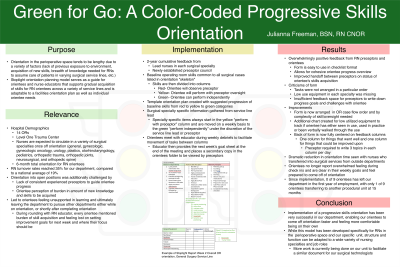
Description: The Orientation Stoplight report serves as a guide for new hire nurses and RN educators to facilitate an efficient skills-based orientation. By sectioning technical skills into progressive categories each week, the stoplight report provides a structured, bite-sized orientation for the new nurses. Recruiting and retaining nurses in the perioperative service line is challenging, with national turnover rates at 19% and our facility at 35%. To retain high-quality recruits and support them during orientation, we sought a process to track progress, ensure technical skills are covered, and improve preceptor handoffs amid a surge in onboarding. In response to this need, our preceptor council, consisting of the department educator and well as 2 registered nurses ,2 surgical technologists and 2 surgical team assistants, created the perioperative nursing stoplight orientation report that replaced our previously ineffective orientation documents. Historically, our department used a standardized checklist for orientation that would list all skills required to become a competent operating room nurse at the end of orientation across all 5 of our main service lines. New RNs provided feedback at weekly debrief sessions with the educator that they had felt overwhelmed at the volume of skills needed in the operating room and had tried to focus on mastering all skills concurrently, leaving their ability to acquire new, complex skills diminished. Based on the tiered skills acquisition model, our stoplight report divides a standard list of perioperative nursing skills skills into red (observe), yellow (perform with guidance), and green (perform independently). At the end of each week, skills are progressed in a stepwise fashion dependent on orientee exposure, performance, and the specified service line. Our initial trial period began with a cohort of a singular nurse. Criticisms of the initial form included task arrangement, lack of low-use equipment tracking, and insufficient feedback space. These criticisms have been addressed in the newest version of this form which is now organized by complexity of skill as well as OR case flow order and fully comprehensive of all equipment. The reverse side of the form was added and serves as a daily feedback form that allows for the preceptor and orientee to take note of which skills should progress into the next column. Initial implementation for the RN orientation report has been overwhelmingly positive. Qualitative feedback from preceptors and orientees notes the form's ease of use, orientee progress overview, and improved preceptor handoffs. The newest version of our orientation form has now been used for 5 RN orientees, with plans to expand the use of the forms to an additional 4 RN orientees this summer and making an adaptation for surgical technologists. Utilizing the perioperative stoplight report has shown to be effective in our department when facing challenges such as an increased number of orientees and utilizing varying preceptors for each orientee. The perioperative stoplight report could be used across job roles in perioperative services to guide orientation and ensure successful onboarding in a difficult specialty.