Operating Room Operations Officer United States Air Force, Nurse Corps Las Vegas, Nevada, United States
Disclosure(s):
Alexis J. carlson, MSN, RN, CNOR: No financial relationships to disclose
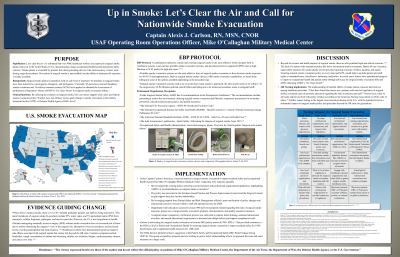
Description: Clinical Problem: Let's clear the air- it's estimated that over 500,000 healthcare workers are exposed to surgical smoke plume each year in the U.S. demonstrating a large occupational health hazard and patient safety concern.4 Smoke plume is a harmful by-product from electrocautery or laser devices during procedures.1 Prevention of surgical smoke is unavoidable, but the ability to minimize the exposure is widely available. Currently, 18 states have enacted mandatory smoke evacuation. However, a consistent nation-wide policy is needed.
Background: Where there's surgical smoke, there's over 80+ harmful pollutants patients and staff are being exposed to. 5 The main breakdown of surgical smoke by-product includes 95% water vapor, and 5% particulate matter from chemicals, cellular fragments, pathogens, and inactive particles.1 However, the 5% is not insignificant to health. Clinical Q: How can nurses support a nation-wide surgical smoke evacuation mandate movement? EBP Protocol: Under Surgical Smoke Safety, AORN has 6 recommendations in the Perioperative Guidelines.3 The recommendations include promoting a smoke-free environment, utilizing surgical smoke evacuation and filtration, respiratory precautions for secondary protection, education/policies/procedures, and quality. NFPA 99: Healthcare Facilities Code calls for the evacuation of all surgical smoke.17 NOISH echoes the call for a safe working environment. Further, ANSI promotes plume evacuation to mitigate and control hazardous exposure.19 Implementation EBP Protocol: As a military nurse, the Defense Health Agency (DHA) oversees the delivery of care to military treatment facilities worldwide. I have partnered with DHA's Occupation Health and Safety Chief working towards enacting a policy for surgical smoke evacuation at 700+ facilities.
Results: Surgical smoke plume is hazardous with no safe level of exposure.1 The average surgical smoke produced in the OR per day is equivalent to 27-30 cigarettes.8,1 Patients undergoing laparoscopic and robotic procedures without smoke evacuation have an increased risk of harm due smoke obstructing the surgeon's view of the surgical site, absorption of toxic by-products, and increased levels of carboxyhemoglobin.1,9-11 Healthcare workers have demonstrated numerous side effects associated with surgical smoke that carries risk beyond the OR suite.
Discussion: Beyond the science and health impacts of surgical smoke, there are also potential legal and ethical concerns.1. The lack of a nation-wide mandatory policy has led to inconsistent smoke evacuation.25 Based off one's location, equal safety measures for smoke plume are not provided spurring concerns of ethics, equality, and equity. Enacting a nation-wide policy would help to up-hold patient and staff rights to nonmaleficence, beneficence, autonomy, and justice. In recent years, there has been progress to improve OR safety by enacting state surgical smoke evacuation bills. OR NSG Implications: The general understanding of the harmful effects of smoke plume exposure has been low among healthcare providers.6 It has been found that nurses are the primary advocate for legislation of surgical smoke evacuation.25 Nurses have a duty to advocate and be involved with policy creation and enactment according to the American Nursing Association's (ANA) code of ethics. Further, nurses belong to the largest and most trusted profession in the U.S. with the potential to have a substantial impact for generations to come.

.jpg "Alexis J. Carlson, MSN, RN, CNOR (she/her/hers) photo")