Perioperative Education Program Coordinator Cleveland Clinic Streetsboro, Ohio, United States
Disclosure(s):
Linda S. Barlett, MSN: No financial relationships to disclose
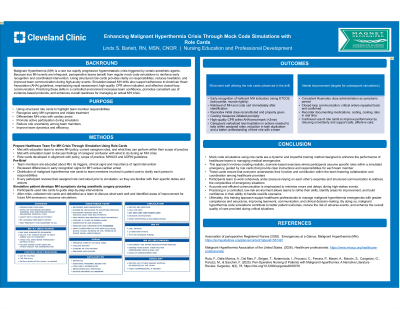
Description: Malignant hyperthermia (MH) is a rare but life-threatening pharmacogenetic disorder triggered by certain anesthetic agents and succinylcholine. Prompt recognition and management are critical to ensuring patient survival. Simulation-based training is an effective method for preparing healthcare teams to respond to MH emergencies. This abstract outline a mock code simulation designed to enhance team preparedness and communication during MH crises using role cards. The simulation involves a multidisciplinary team, including anesthesiologists, nurses, surgical technicians, working collaboratively with the simulation team to manage an MH scenario. Role cards are distributed to participants, clearly defining their responsibilities during the crisis. Examples of roles include anesthesia, circulator, surgeon, medication nurse, and documentation nurse. These cards provide specific instructions, such as administering Ryanodex, cooling the patient, monitoring vital signs, and ensuring accurate documentation of interventions. The mock code begins with a simulated patient undergoing anesthesia who develops signs of MH, including hypercarbia, tachycardia, muscle rigidity, and hyperthermia. Participants must identify the condition, activate the MH protocol, and perform interventions such as discontinuing triggering agents, administering Ryanodex, calling MH hotline number, initiating active cooling measures, and managing complications like arrhythmia. The role cards facilitate structured communication, task delegation, and adherence to evidence-based guidelines, ensuring efficient team coordination. After the simulation, a debriefing session is conducted to review performance, address gaps in knowledge, and reinforce best practices. This mock code simulation using role cards aims to improve healthcare teams' ability to manage MH emergencies effectively, reduce response times, and enhance patient outcomes. By fostering teamwork and reinforcing critical actions, this training method equips providers with the skills necessary to navigate high stakes situations.