Chief Nursing Officer Reeves Regional Health Pearland, Texas, United States
Disclosure(s):
JohnRich R. Levine, DNP, DPA, DBA: No financial relationships to disclose
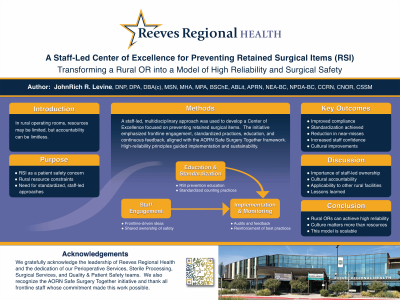
Description: Description of Team The RSI Prevention Task Force was a multidisciplinary team composed of perioperative nurses, surgical technologists, anesthesia providers, sterile processing technicians, and supply chain staff. This collaborative group took collective ownership of implementing a systems-based, high-reliability approach to retained surgical item (RSI) prevention.
Preparation and Planning Preparation began with a departmental commitment to achieve designation as a Center of Excellence in RSI Prevention. The team aligned its efforts with national guidelines and the AORN Guideline for Prevention of Retained Surgical Items. Staff engagement was built through inclusive planning meetings, review of historical gaps, and identifying key education priorities.
Assessment A baseline assessment of count accuracy, compliance with sponge, sharps, and instrument tracking, and staff confidence in count protocols was conducted. Direct observational audits and team debriefs highlighted inconsistencies in workflow and communication across the perioperative continuum.
Implementation The team launched a staff-led educational program that included:
Required competencies on count protocols and documentation
Visual cues and cognitive aids placed in key procedural areas
Simulation drills with post-event debriefing
Non-punitive audits with real-time coaching
Evaluation of adjunct technologies such as radiofrequency tracking and AI-based count systems
Outcome
100% staff completion of RSI education within 8 weeks
A rise in self-reporting of near-miss events with effective resolution follow-up
Verified compliance with sponge, sharps, and instrument count protocols
Enhanced interdisciplinary teamwork based on post-implementation survey feedback
Zero RSI incidents within 6 months post-implementation
The unit entered the readiness phase for RSI Center of Excellence designation
Implications for Perioperative Nursing This initiative exemplifies how nurse-led engagement, structured education, and sustained accountability can drastically improve surgical safety. It reinforces that frontline ownership—supported by AORN guidelines—can create cultural transformation, even in small or resource-limited settings. This model can be replicated across institutions aiming for high-reliability and patient-centered outcomes in perioperative care.

.jpg "JohnRich R. Levine, DNP, DPA, DBA (he/him/his) photo")