Clinical Manager Joe DiMaggio Children's Hospital Pembroke Pines, Florida, United States
Disclosure(s):
Vaneker Johnson, BSN RN CNN: No financial relationships to disclose
Description:
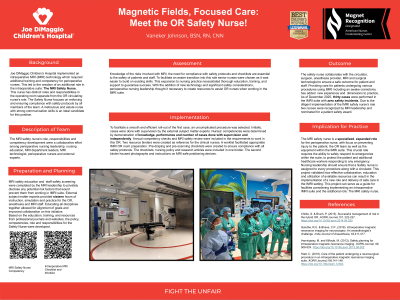
Background: A free-standing children's hospital was implementing intraoperative MRI (IMRI) technology which required additional training and competency for perioperative nurses. This led to the creation of an additional role in the intraoperative suite: The MRI Safety Nurse. This nurse has distinct roles and responsibilities in the operating room separate from the OR circulating nurse's role. The Safety nurse focuses on enforcing and ensuring compliance with safety protocols by all members of the team.
Description of team: The MRI safety nurse's role, responsibility and competency development were a collaborative effort among perioperative nursing leadership, nursing education, MRI department leaders and perioperative nurses.
Preparation and Planning: MRI safety education and personal evaluations were completed by the MRI leadership. External subject matter experts provided sixteen hours of instruction, simulation and practice for the OR and MRI staff. Based on the education, training, and resources from professional journals and websites, the policy, competencies, role and responsibilities for the Safety nurse were developed.
Assessment: As this was a new role with new technology and significant safety considerations, perioperative nursing leadership thought it necessary to create resources to assist OR nurses when working in the IMRI suite. Implementation: Two resource binders were created as reference for the nurses. A worklist facilitated appropriate IMRI OR room preparation. Pre-draping and pre-scanning checklists were created to ensure compliance with all safety protocols. The checklists, nursing policy and research articles were included in one binder. The second binder housed photographs and instructions on MRI safe positioning devices. Initially, cases were done with supervision by the external subject matter experts. Nurses were credentialed based on knowledge, performance and number of cases done with supervision and independently. Annual competency checks and MRI safety review were included in the requirements to work in this OR.
Outcome: The role of the MRI safety nurse involves working with the RN circulator, anesthesia provider, MRI technologist and scrub technologist to ensure the safety of the patient and staff. As of June 2025, thirty cases have been performed in the IMRI suite with zero safety incidents. Additionally, due to the diligent implementation of the IMRI safety nurse's role and protocols, two perioperative nurses were recognized by MRI leadership and nominated for a patient safety award.
Potential Implications for perioperative nursing: The MRI safety nurse is a specialized, expanded role for the perioperative nurse, with focus on preventing injury to the patient, the OR team as well as the equipment within the IMRI suite. This crucial role requires the ability to safely respond to emergencies within the suite, to protect the patient and additional healthcare workers responding to any emergency. Nursing leadership should ensure that a Safety nurse is assigned to every procedure along with a circulator. This project validated how effective collaboration, education and utilization of available resources can result in the implementation of a new role and delivery of safe care in the IMRI setting. This project can serve as a guide for facilities considering implementing an intraoperative IMRI suite and the additional role: The MRI safety nurse.

.jpg "Vaneker Johnson, BSN RN CNN (she/her/hers) photo")