Assist Prof Izmir University of Economics Izmir, Izmir, Turkey
Disclosure(s):
Ebru Dığrak, n/a: No financial relationships to disclose
Description:
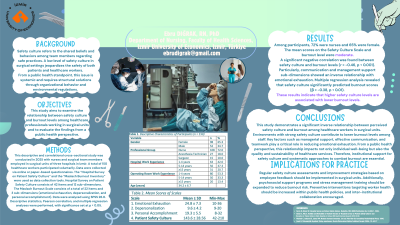
Objective: Safety culture refers to the shared beliefs and behaviors among team members regarding safe practices. A low level of safety culture in surgical settings jeopardizes the safety of both patients and healthcare workers. From a public health standpoint, this issue is systemic and requires structural solutions through organizational behavior and environmental regulations. This study aims to examine the relationship between safety culture and burnout levels among healthcare professionals working in surgical units and to evaluate the findings from a public health perspective.
Methods: This descriptive and correlational cross-sectional study was conducted in 2025 with nurses and surgical team members employed in surgical units of three hospitals in İzmir. A total of 150 healthcare workers participated voluntarily. Data were collected via online and/or paper-based questionnaires. The "Safety Culture Scale" and the "Maslach Burnout Inventory" were used as data collection tools. While the Safety Culture Scale measures employees' perceptions of organizational safety, the Burnout Inventory assesses emotional exhaustion, depersonalization, and personal accomplishment sub-dimensions. Data were analyzed using SPSS 26.0. Descriptive statistics, Pearson correlation, and multiple regression analyses were performed, with significance set at p < 0.05.
Results: Among participants, 72% were nurses, 18% anesthesia technicians, and 10% surgeons; 65% were female and 35% male. The mean age was 34.2 (± 6.7). The Safety Culture Scale total mean score was 3.42 (± 0.68), and the emotional exhaustion subscale mean score was 24.8 (± 7.3). A significant negative correlation was found between safety culture and burnout levels (r = -0.46, p < 0.001). Particularly, communication and management support sub-dimensions showed an inverse relationship with emotional exhaustion. Multiple regression analysis revealed that safety culture significantly predicted burnout scores (β = -0.38, p < 0.01). These results indicate that higher safety culture levels are associated with lower burnout levels.
Conclusion: This study demonstrates a significant inverse relationship between perceived safety culture and burnout among healthcare workers in surgical units. Environments with strong safety culture contribute to lower burnout levels among staff. Key factors such as managerial support, effective communication, and teamwork play a critical role in reducing emotional exhaustion. From a public health perspective, this relationship impacts not only individual well-being but also the quality and sustainability of healthcare services. Therefore, institutional support for safety culture and systematic approaches to combat burnout are essential. Regular safety culture assessments and improvement strategies based on employee feedback should be implemented in surgical units. Additionally, psychosocial support programs and stress management training should be expanded to reduce burnout risk. Preventive interventions targeting worker health should be increased within public health policies, and inter-institutional collaboration encouraged.