Nurse Scientist; Chief Nursing Officer United States Army Nurse Corps; Brian D. Allgood Army Community Hospital APO, Armed Forces - AP, United States
Disclosure(s):
Christopher H. Stucky, PhD, RN, CNOR, CSSM, CNAMB, NEA-BC, FAORN, FAAN: No financial relationships to disclose
Description:
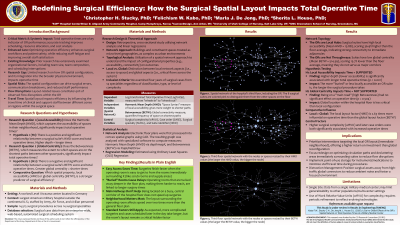
Problem/Purpose Total operative times are key indicators of surgical performance and operating room (OR) efficiency. While organizational and team factors influencing these times have been studied, the OR spatial layout is an understudied factor. This study aims to bridge this gap by using a spatial network approach to examine the association between operating room layout and total operative times.
Literature Review The OR's spatial layout impacts work processes affecting operative times, patient safety, and efficiency. Poor layouts lead to surgical errors, hinder team communication, disrupt circulating nurse flow, and reduce staff performance. Layout issues also influence staff travel time. Optimizing OR efficiency often involves proximity to areas like emergency or radiology departments.
Research Question/Hypothesis This study investigates how local and global properties of the OR's spatial layout correlate with total operative times. Hypothesis 1: A positive, significant relationship exists between a surgical suite's Harmonic Mean Depth and total operative times. Hypothesis 2: A negative, significant relationship exists between a surgical suite's Betweenness and total operative times.
Conceptual Framework The study uses a spatial network approach, viewing building spaces as micro-geographies. Drawing from space syntax analysis, it examines local and global OR network aspects. Harmonic Mean Depth measures local accessibility/reachability, influencing surgical processing and case times. Betweenness quantifies global flow path importance, indicating the potential for disruptions.
Methodology We analyzed 14,515 surgical procedures performed in eight OR suites at a U.S. military medical center between January 2019 and January 2023. This was a retrospective, cross-sectional study using five years of surgical procedure data.
Data Analysis Ordinary least squares linear regressions were used to model the relationship between log-transformed total operative time (dependent variable) and OR spatial network variables (Harmonic Mean Depth, Betweenness). Surgical complexity (work Relative Value Units), case order, surgical suite identifier, and surgical specialty were control variables.
Results Harmonic Mean Depth showed a significant positive correlation with total operative times, even after controlling for other factors. Betweenness was not significantly associated with total operative times. Harmonic Mean Depth's influence on operative times was 2.63 times greater than Betweenness's.
Conclusions/Discussion Targeted design interventions on local aspects of OR layout can significantly improve surgical workflows, patient safety, and staff performance. This study provides a framework for such interventions. Optimizing local OR connectivity and strategic equipment placement can enhance efficiency and reduce operative times by mitigating flow disruptions.
Perioperative Nursing Implications Optimizing operative times benefits patients, staff, and healthcare systems by improving scheduling and resource allocation. For military settings, informed OR configuration in field hospitals can improve time to life-saving surgery for combat casualties and aid in mass casualty management. Surgical leaders should prioritize local OR spatial design optimization due to its greater impact on operative times compared to global centrality, offering a strong return on investment for surgical performance improvements.

.jpg "Christopher H. Stucky, PhD, RN, CNOR, CSSM, CNAMB, NEA-BC, FAORN, FAAN photo")