Assistant Nurse Manager UCLA Santa Monica Medical Center Beverly Hills, California, United States
Disclosure(s):
Samantha Marinelli, RN, BSN, MSN, CNOR: No financial relationships to disclose
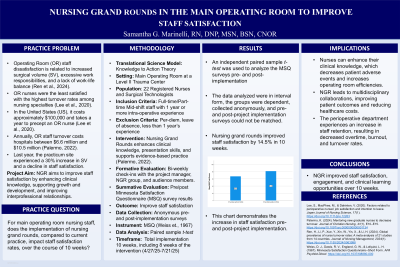
Description: Clinical Improvement/Innovation Poster: Evening Shift Nursing Staff: Main Operating Room 25 participants Ages 23-60 Education: BSN, MSN, Certified Surgical Technologist (CST) Preparation/Planning: I completed a site assessment with the department educator and peroperative director, and unit director. After reviewing their annual staff surveys, we identified decreased staff satisfaction related to increased surgical case volume and decreased learning, growth, and development opportunities as the main area of concern. I began researching medical grand rounds and discovered Nursing Grand Rounds (NGR) as a proven method of clinical education. I started my research synthesis, JH summary, and presented it project stakeholders, where it was met with great support and approval. I picked NGR topics, crafted an education plan, created a schedule, outlined the ten-week timeline, identified potential barriers, created a budget, educated the participants and gained the support, created the groups, assigned their topics, and implemented NGR. Topics: Continuity of care and how it impacts patient outcomes, open vs. laparoscopic vs robotic surgical cases, OR culture: Nursing makes the difference, and bioburden's impact on intr-operative care NGR was implemented over ten weeks to improve clinical learning opportunities, staff engagement, mentorships, and staff satisfaction. 4 topics were presented, one topic every two weeks, at the staff in-service. The staff were grouped A, B, C, and D (4 to a group) with an assigned group champion. Outcomes were measured using the Minnesota Satisfaction Questionnaire pre- and post-intervention. MSQ satisfaction pre-intervention was 66.92% and MSQ satisfaction post-intervention was 78.10%. NGR improved staff satisfaction by 11.26% over 10 weeks. A statistician was hired to help with data analysis and interpretation. Peri-operative nursing implications related to NGR include, but are limited to, enhancing nurses' clinical knowledge, which decreases patient adverse events such as incorrect surgical counts, medication errors, and bioburden incidents. NGRs lead to multidisciplinary collaborations that improve OR efficiencies, that impact patient outcomes and experiences, that ultimately reduce healthcare costs. This type of culture engages and empowers nursing staff to initiate best practice, support change, and mentor staff. Across the United States, the average length of orientation time is 6-12months, costing OR departments approximately $100,000 per nurse. NGR educates, mentors, and develops nurses for long-term career growth. This environment strives to increase retention within the perioperative department while supporting internal growth and development among its OR staff in a highly cost-effective manner.