Clinical Nurse Specialist Perioperative and Procedural Services ECU Health Greenville, North Carolina, United States
Disclosure(s):
Shawna McClung, MSN, APRN, AGCNS-BC, CNOR: No financial relationships to disclose
Description: Perioperative nurse leaders from a large health system in Eastern North Carolina identified the need to extend the AORN PeriOp 101 program beyond the main Medical Center to encompass seven regional hospitals.
Leaders within the regional hospitals were unfamiliar with how the PeriOp 101 program was structured but they knew they wanted to try it out. After reviewing the program through AORN and learning what the orientation path for the new nurse in the operating room could look like, a proposal to the Professional Development leadership team was developed.
Spring of 2024 a learning needs assessment was performed at the regional hospitals to determine which facility had nurses who were formally trained with the PeriOp 101 program. At most, each facility had two to three nurses who had received the program. Additionally, some nurse leaders lacked formal experience working in the operating room, placing them at a disadvantage when onboarding new staff.
Projected current needs and hiring were determined. In November 2024, the PeriOp 101 program and CineMed videos were purchased for 40 learners across the region. Two limitations were identified with the plan. One, there was no formal educator to administer the program. Two, some of the learners were already in staffing and had been employed for over two years. Getting them out of staffing would be a challenge.
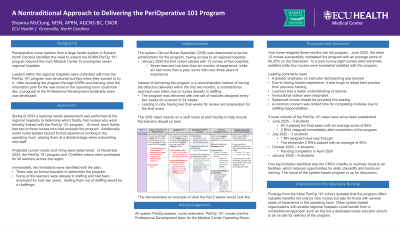
The system Clinical Nurse Specialist (CNS) was determined to be the administrator for the program, having access to all regional hospitals. January 2025 the first class started with 13 nurses at five hospitals. Seven learners had less than six months of experience, while six had more than a year, some with over three years of experience. Instead of delivering the program in a recommended method of having the didactics delivered within the first two months, a nontraditional approach was taken due to nurses already in staffing. The program was delivered with one set of modules assigned every two weeks for a period of 24 weeks. Leading to only having two final weeks for review and preparation for the final exam. The CNS relied heavily on a staff nurse at each facility to help ensure the learners stayed on task. Another limitation identified was the CNS's inability to routinely travel to all five facilities, which reduced opportunities for skills checkoffs and hands-on training.
One nurse resigned three months into the program. June 2025, the other 12 nurses successfully completed the program with an average score of 95.25% on the final exam. In a post survey eight nurses were extremely satisfied while four nurses were somewhat satisfied with the program. Leading comments were 1) a greater emphasis on instructor-led teaching was desired 2) due to having biased experience it was tough to adopt best practice from formal training 3) learners had a better understanding of rational 4) instructional videos were redundant 5) seasoned nurses should be provided this training and 6) a common concern was limited time for completing modules due to staffing responsibilities.
Findings from the initial PeriOp 101 cohort revealed that the program offers valuable benefits not only for new nurses but also for those with several years of experience in the operating room. May and June cohorts have been formed with a mix of experienced nurses. An August cohort is scheduled. Other system-based organizations with smaller regional hospitals could benefit from a nontraditional approach such as this but more research needs to be conducted.