Quality and Patient Safety Advisor- Perioperative Services Vanderbilt University Hospital, Tennessee, United States
Disclosure(s):
Angela Balding, BSN, RN, CNOR, CPHQ: No financial relationships to disclose
Description:
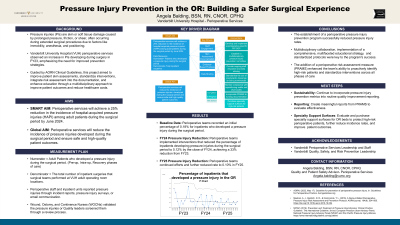
Description of Team: The pressure injury (PI) prevention initiative at Vanderbilt University Hospital (VUH) perioperative services was led by a multidisciplinary team that included perioperative nurses and leaders, wound, ostomy, and continence (WOCN) nurses, quality leaders, and clinical educators. Preparation and Planning In FY23, perioperative services identified an increase in hospital-acquired pressure injuries (HAPIs) developed during surgery, prompting the need for targeted prevention strategies. The team conducted a thorough review of PIs reported through incident reports and PI prevalence surveys, that were validated through a process led by WOCN nurses and quality leaders. Guided by the AORN Guideline for Prevention of Perioperative Pressure Injury, the team established a SMART goal and action plan.
Assessment: The team conducted a thorough analysis of recurring contributing factors, identifying several critical areas for improvement. Inconsistent skin assessments were found to hinder the early identification of patients at risk for PIs. Additionally, prophylactic dressings were not being utilized consistently or as frequently as recommended. A lack of staff awareness and education regarding PI prevention further limited the adoption of best practices. These insights guided the development of targeted interventions aimed at closing practice gaps, enhancing staff knowledge, and standardizing patient care processes.
Implementation: The quality improvement initiative was launched with several key components: Creation of a perioperative specific pressure injury prevention SOP to standardize practices across the preoperative, intraoperative, and postoperative phases of care. Implementation of the Perioperative Risk Assessment Measure for Skin (PRAMS) tool in nursing documentation. Comprehensive education for staff and providers on PI prevention strategies, risk assessment, and proper positioning techniques. Multidisciplinary collaboration to ensure consistent application of interventions and promote accountability. Routine data sharing and performance monitoring to track progress and sustain improvements. Sustainability measures, include routine reporting, evaluation of interventions, and future investments in specialty support surfaces.
Outcome: The perioperative PI prevention program successfully achieved and exceeded its SMART goal: to achieve a 25% reduction in HAPIs among adult surgical patients by the close of FY24 (June 2024). At the start of FY23, the percentage of inpatients who developed a PI during surgery was 0.18%. By the close of FY24, this rate decreased to 0.12%, representing a 33% reduction. In FY25, the rate further decreased to 0.10%, demonstrating sustained improvement.
Implications for Perioperative Nursing: This initiative underscores the critical role of perioperative nurses in driving patient safety and quality improvement efforts. The adoption of the PRAMS tool enhanced nurses' ability to proactively identify high-risk patients and implement targeted interventions across all phases of perioperative care. Standardized protocols, education, and multidisciplinary collaboration empowered perioperative nurses to lead efforts in reducing PI rates and fostering a culture of safety. By integrating evidence-based guidelines, perioperative nurses can strengthen their practice, improve patient outcomes, and advocate for patient-centered care.